Ventilation: Enhancing communication to deliver health outcomes
Arnaud D., mechanical ventilation (NIV) expert, embodies the Air Liquide Healthcare's patient centric approach with an innovation allowing to improve communication with patients
Published on
9 minutes
- Ventilation
- Value based healthcare

My concern : find a way to give a voice to patient on a ventilator
Arnaud: For 33 years, I've closely supported patients battling chronic respiratory failures. Some of the most heartbreaking moments were with people who could no longer speak, their voices stolen by their illness. Imagine their frustration, their fear, unable to express how they felt about the treatment that was meant to help them breathe easier. Those patients are dependent on a machine to breathe, and yet they can't tell you if it feels right, if it's too much, too little... You do your best to understand them, but sometimes I felt so helpless. That frustration fueled me. I had to find a way to give them a voice. My role is really to represent the reality of a patient on a ventilator, what is actually happening on the ground. It is crucial for Air Liquide Healthcare to understand who patients and caregivers really are. Figuring out how to adjust settings, as a result of the balance between therapy efficacy and patient tolerance. I really wanted to understand, patient by patient, the right way to ventilate them properly. The early discussions with doctors were also essential and the main key lesson is the absolute necessity of a personalized approach—ventilation is not a “one size fits all” solution.
Finding the right balance between comfort and efficacy
What is mechanical ventilation?
Arnaud: Non-invasive ventilation (NIV) is a respiratory support method that uses a mask to deliver air from a ventilator to a patient's lungs, avoiding the need for an invasive breathing tube. It's a widely used treatment for chronic respiratory failure, particularly in the home setting. However, successfully integrating NIV into a patient's life hinges on their comfort and acceptance of the therapy. For a patient receiving mechanical ventilation, a key challenge is communicating their subjective feelings about the therapy. What is the patient's experience—whether the pressure feels "too much" or "not enough"—is subjective and vital for optimal settings. Without an objective way to share this feedback, physicians, nurses or technicians can struggle to make the precise adjustments needed to improve tolerance and, as a result, therapy adherence.
As caregivers, it is always a challenge to find the right balance between what the patients can tolerate and what we want in terms of treatment efficiency.
In other words, the healthcare professionals seek both:
- acceptable settings for the patient which impact the tolerance of the ventilation device
- expected therapeutic outcomes which linked to efficacy
Mechanical ventilation can be challenging for patients and healthcare professionals alike
Arnaud: The best way to help both patients and caregivers was to facilitate information sharing among them, the communication being difficult, sometimes impossible. The first step was to find a common language and a frame of questions and answers to define the best settings. An experts group has been created to define the 5 main settings1 for acting on tolerance to spontaneous ventilation. They are:
- inspiratory pressure
- expiratory pressure
- inspiration time
- rise time
- trigger sensitivity
- The patient's lung is inflated by the inspiratory pressure (1) generated by the ventilator.
- When the pressure drops to the level of the expiratory pressure (2), the lung "empties".
- The during of the inspiration time (3) is crucial to maximize the alveolar gas exchanges.
- The shorter the rise time (4), the faster the air enters the lungs. This value depends on respiratory pathologies.
- The inspiratory trigger sensibility (5) will influence the onset of inspiratory pressure build-up. It is adjusted to synchronize with patient demand.
How patient communication is a game-changer in ventilation
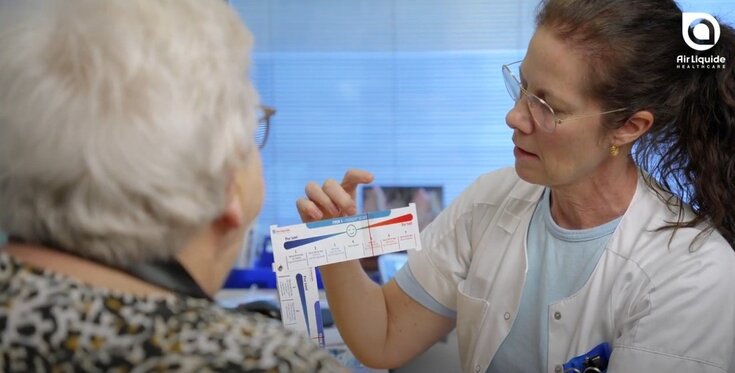
The 'Ventilation Experience Tool’
Arnaud: We worked closely with the Aalborg hospital team in Denmark. Thanks to them, Air Liquide Healthcare has improved the ‘Ventilation Experience tool’ prototype. Patients need to know that you understand how they feel—the fear, the anxiety—but also that you can solve their technical problems and really listen to them, so you can then find the most appropriate solutions. Ventilation adjustment is not just technical or medical. Every ventilated patient, at some point, has difficulty communicating their needs during these critical adjustments. The ‘Ventilation Experience Tool” bridges that gap. It opens up a whole new level of communication and trust between the patient and the care team. If we can empower patients to become more involved and restore a sense of control, that's a win in my book!
Connecting quickly with the patient
Arnaud: The collaboration with caregivers allowed me to fine-tune the prototype. Their practices were integrated in the tool with the objective that it could be used both at hospital and at home during the regular visits. In detail, we invented a decision-support instrument that leverages patient-reported outcomes (PROMs). The operator facilitates feedback by asking simple and understandable questions for the patient. The patient subjectively rates his/her comfort level by adjusting a cursor in a scale from 1 to 7 to reflect their preferred feeling or tolerance on each setting. This input instantly provides the operator with suggested setting adjustments tailored to the patient’s feedback. Our ‘Ventilation Experience Tool’ simplifies a complex process: patients use a sliding bar to rate their comfort level, and this feedback provides the healthcare professionals with suggested ventilator adjustments. It's a game-changer for patients who struggle to articulate their feelings, including those who are no longer able to speak. This innovation empowers patients to actively participate in their care, fostering a powerful connection with their caregivers and restoring a sense of control. Our tool could be used at 3 and 12 months follow-up.
360° testimonials: from physician, nurse and patient
-
The ‘Ventilation Experience Tool’ helps us remember the possible side effects and difficulties the patients might have with the ventilator and how we can optimize their tolerance. In that way, the tool has been of great value.
Communication with patients is sometimes hard. It is very hard for the patients to express exactly how they feel dyspnea, exactly how the sensation from the mask is and how exactly they feel the pressure from the machine affecting them. Therefore, it has been a great help to have this tool in our communication with the patients. Now we can actually talk to them whilst they are receiving treatment. They can score themselves on dyspnea, on sensation of different kinds during the actual treatment. So therefore, the tool is not only a great helper for communicating with each other between caregivers, it is very much a good tool for communicating between caregivers and patients.
-
This tool allows us to objectively measure subjective sensations that the patient has when adopting non-invasive ventilation (NIV), being very useful and making communication much easier.
When we are adapting a patient to non-invasive mechanical ventilation, a problem we have very often is communication with him. It is difficult to know what feeling is with the interface exposed, if the pressure we have set is adequate or if it is too strong. This is very important to adapt well. With the ‘Ventilation Experience Tool’, it makes this work much easier for us. It is a very easy-to-use visual tool, so the patient can rate himself on various sensations that he will have with ventilation. Then you can tell if you notice too much pressure or if it is adequate, if it costs you a lot or little for the ventilator to assist him or another series of perceptions that he is having.
-
These relationships are based on deep trust. That's why I use the “ventilation experience tool” - as an additional tool to my usual assessment - when the patient reports discomfort during the home visit.
With extensive experience in pulmonary rehabilitation centers, I feel the most important thing is to ensure that the patient or his/her caregiver feels independent and confident in managing the devices. Beyond the technical aspects, it's about the human connection. These relationships are based on deep trust. That's why I use the “ventilation experience tool” as an additional tool to my usual assessment, to check settings when the patient reports discomfort during the home visit. This makes the patient reflect on their treatment and it gives me a consistency in communication both with the patients but also with the healthcare professionals at the hospital. This way we can change settings on the ventilation device for a better experience
-
I breathe and reflect what I feel by using the tool to answer HC provider’s questions. I think the tool is absolutely perfect when I am wearing the mask.


In facts: a recognized innovation
The ‘Ventilation Experience Tool’ has already proven to be very promising. According to a survey2 conducted in several countries among 57 healthcare professionals in France, Spain, Korea, and Germany, the ‘Ventilation Experience Tool’ achieved a satisfaction score of 4.1 out of 5. The results highlight that the tool contributes significantly to:
- Involving patients in their therapy
- Improving communication between patients and healthcare providers and understanding the patient experience
- Saving healthcare professionals time and simplifying their practice
-
4.3/5
Patient experience & understanding improvement
-
4.1/5
Patient communication improvement
-
4.1/5
Saving time for healthcare professionals
-
4.1/5
Overall satisfaction by healthcare professionals
Summary: the future of Value-based Healthcare in non-invasive ventilation (NIV)
Air Liquide Healthcare's 'Ventilation Experience Tool’ is a clear example of Value-based Healthcare in action. By focusing on improving patient comfort and communication, the tool aims to increase therapy adherence and clinical outcomes and thus improve the entire care process. This is a modest but important step toward patients and healthcare professionals working together to achieve better health outcomes.
To remember
-
The ‘Ventilation Experience Tool’ is a simple visual tool to ease the communication between patient and healthcare professionals with the aim to objectively share patient’s comfort and improve device settings.
-
By developing tools that put patients at the center of their treatment, Air Liquide Healthcare aims to improve compliance and health outcomes that matter to patients.The ‘Ventilation Experience Tool’ could be used at hospital and during visits at home to improve the initiation process but also the support follow-up.
-
Surveys and testimonials show that the ‘Ventilation Experience Tool’ is appreciated by patients and healthcare professionals.
1: https://splf.fr/wp-content/uploads/2022/01/ConseilsGAVO2-2022-fiche.pdf
2: A multicountry survey conducted in January 2025 to assess healthcare professionals (HCP) satisfaction and perceived clinical relevance of the tool. Participants completed an online questionnaire evaluating overall satisfaction, and specific benefits from 0 (low) to 5 (high). The survey was completed by 57 HCPs in 4 countries. The results are : Mean satisfaction 4.1/5. Patient involvement 3.9/5. Patient communication 4.1/5. Patient experience and understanding 4.3/5. HCPs saving time 4.1/5. HCPs practice simplification 3.9/5.